
Humanoid robotics doesn't start with the demo, it starts with responsibility
Humanoid robots fascinate with their agility. But whether a system may be used productively is not decided by capability alone — it depends on whether its behaviour is safe, traceable and controllable in a specific environment. This is exactly where we come in.
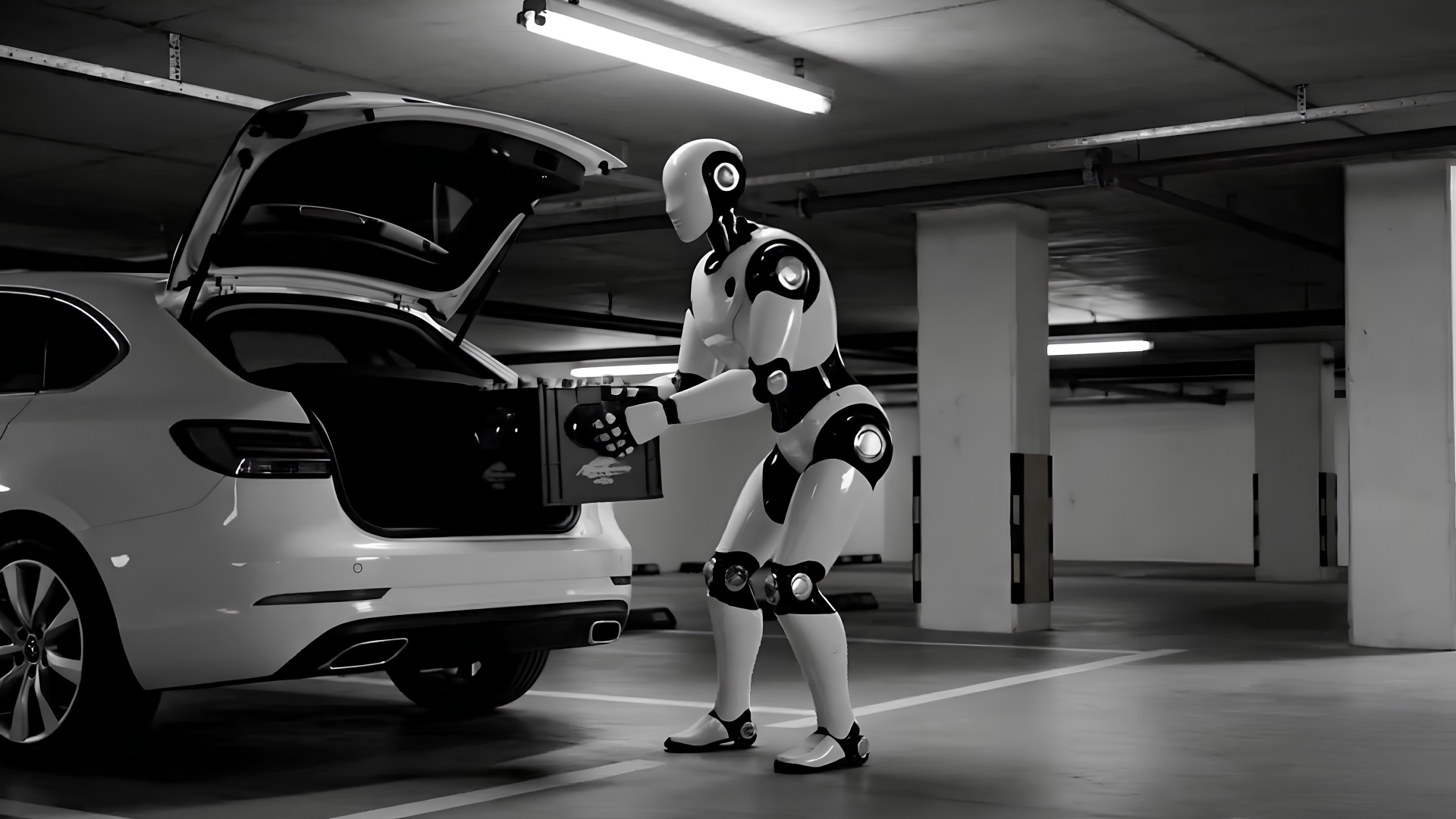
Machines designed to fit into our world
A humanoid robot is a system with a human-like form, with arms, grippers and a mobile or bipedal base. The idea behind it: instead of adapting the environment to the robot, the robot should be able to use environments made for people — stairs, doors, tools, workstations. This makes humanoid systems versatile, but also far more demanding in terms of safety and operation than a fixed industrial robot.
Humanoid robots should not be judged by their capabilities alone. What matters is whether their behaviour in a specific environment is sufficiently safe, traceable and controllable.
A pure demonstration of mobility is not enough. For productive use, the task, environment, risks, protective measures, operating concepts and responsibilities must be assessed.
From impressing to operating
The real effort lies not in the first demonstration, but in the transition between these stages.
1 · Demonstration
Controlled conditions, defined sequences. Shows the potential, but not everyday operational safety.
2 · Pilot operation
Testing under real but supervised conditions. Initial risks, interfaces and protective measures become visible.
3 · Productive operation
Permanent, independent use with operator duties, a safety concept and demonstrable safety.
 Humanoid systems in open living spaces: no safety fence, direct proximity to people and animals
Why humanoid robotics must be assessed differently
- Open environments. No safety fence separates people and machine. Safety must lie in the behaviour itself.
- Changing tasks. What works today may fail tomorrow in a slightly different situation.
- Human-robot proximity. Forces, speeds and evasive behaviour must remain controllable.
- Traceability. The system's decisions must be explainable and documentable.
- Clear responsibilities. Who operates, who maintains, who intervenes when in doubt?
Support from assessment to operational approval
We support manufacturers, operators and integrators — with the perspective of a company that operates robotics itself.
Clarify use case & environment
Which task, which space, which people, which mode of operation? Without this context, no serious assessment is possible.
Pre-audit & safety evaluation
Structured initial assessment of risks and open issues before investing in pilot or productive operation.
Risk assessment & safety concept
Assessment of relevant hazards and derivation of technical and organisational protective measures.
Integration & operational approval
Safe integration into the real working environment and preparation of the documentation for a traceable approval.
Certification strategy
Development of viable strategies for CE assessment and future certification of humanoid systems.
Maucher CNC-Robotic does not provide legal advice and is not an independent inspection body. For machines we develop and manufacture ourselves, we assume technical manufacturer responsibility – technical evaluation, risk assessment, documentation and preparation of the relevant evidence, carried out by our machine-safety expert certified by TÜV NORD. For external projects we provide technical support but do not issue legally binding conformity assessments or legal opinions; legally binding assessments, official classifications or legal questions must, where necessary, be coordinated with notified bodies, inspection organisations or specialised legal experts.
Staying honest: what isn't (yet) possible today
We don't believe in exaggerated promises. In open, unpredictable environments, current humanoid systems are still of limited reliability, comparatively energy-hungry and technically demanding when it comes to safe human-robot interaction. Long autonomous deployments without supervision are not yet feasible in many scenarios.
Realistic projects therefore start with clearly defined tasks in a manageable environment and grow with increasing maturity. This pragmatic path leads to viable operation faster than trying to map everyday life in all its complexity straight away.
Humanoid robotics put in perspective
Are you planning a humanoid deployment?
Bring us your use case. We'll assess what is sensibly feasible today and which steps lead to safe, traceable operation.