
The humanoid housemate and the underestimated risk of everyday life
When, around a quarter of a century ago, we set about teaching industrial robots the so-called "bin picking", every step of progress felt like a feat of strength. Weeks and months of development work were needed to make seemingly trivial actions reproducible and reliable.
By comparison, it was relatively easy to deploy robots in clearly defined industrial environments. Behind safety fences, with known geometries and predictable processes, they could carry out their tasks precisely and safely. The humanoid developments of recent years have fundamentally changed this situation.
Advances in physical AI as well as in perception, motion planning and interaction are progressing at enormous speed. Digital twins and their "cousins" are developing a robust understanding of the world and translate complex real-world requirements into machine-readable structures. Systems that used to be designed exclusively for rigid industrial processes are increasingly beginning to capture open and dynamic environments as well.
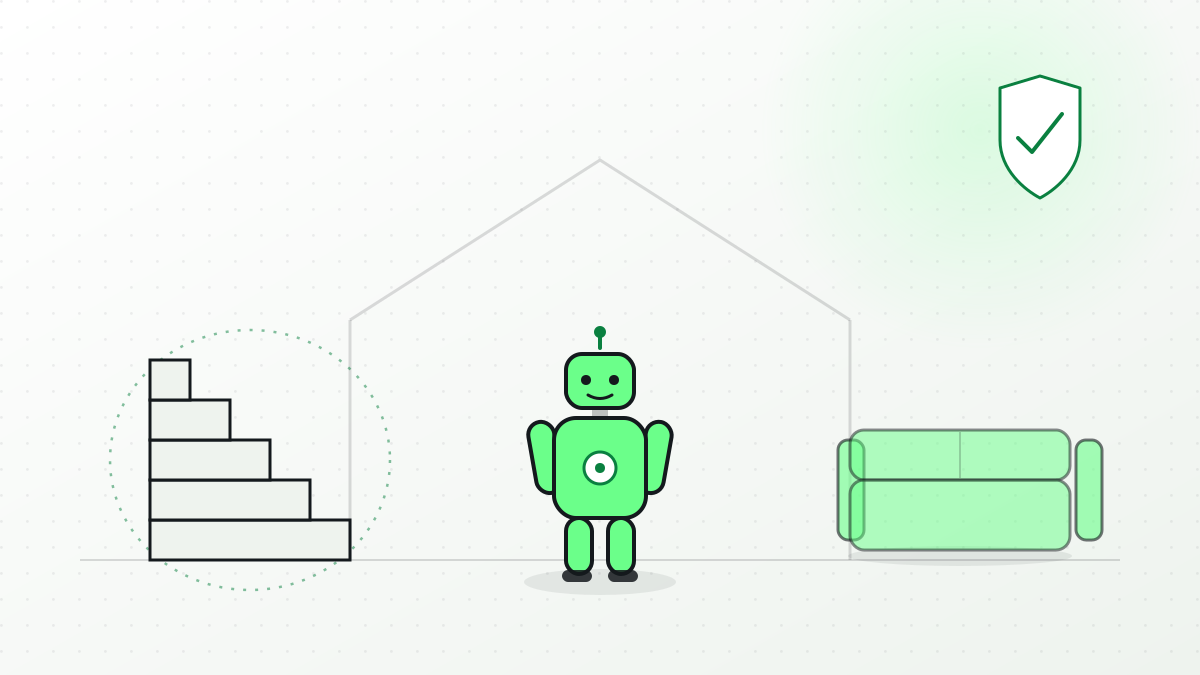
With this development, the field of application shifts from industry towards private living spaces. But this is exactly where the comfort zone of classic robotics ends. In the home there are no safety fences, no standardised processes and no clearly delimited danger zones. People, children and pets move unpredictably, situations change spontaneously, and risks arise not from operating errors but from everyday life.
This new openness should always be considered in parallel. Not in the form of additional safeguards that paralyse every action, but dosed in such a way that new hazards do not become greater than those that already exist. Otherwise, alongside the well-known challenge of the "sim-to-real gap", another, often underestimated risk arises: the safety gap between industrial control and private reality. If this is not consciously addressed, it grows with every new capability of the systems.
Household accidents are among the most constant and at the same time least noticed risks of modern societies. While road accidents, industrial safety or medical emergencies regularly receive public attention, a considerable proportion of serious and fatal accidents takes place in the private environment. Statistically, around every second fatal accident in Germany occurs in the domestic sphere. Falls in particular dominate, both in frequency and in the severity of the consequences. This starting situation makes the home a relevant field of application for robotics and autonomous systems.
However, the safety-relevant benefit of humanoid robotics does not begin only during operation, but considerably earlier. It is crucial that a humanoid robot is not placed in any arbitrary home as a universal all-purpose actor, but is designed from the outset for a concretely specified domestic environment. Households differ structurally and dynamically more than it appears at first glance. An apartment with small children follows different movement patterns, danger zones and priorities than a care household or a single-person household with a workshop and garage. Pets change routes, reaction times and collision risks. Care needs shift the focus from prevention towards monitoring and rapid escalation.
These differences are not marginal conditions, but safety-critical foundations.
The real lever therefore lies in decentralised advance specification. Even before a humanoid robot becomes active, it must be clearly defined in which context it works, which actors are regularly present and which risks dominate. On this basis the robot can act not abstractly but context-aware. Movement spaces, interaction distances, force limits and reaction logics can be adapted exactly to the real living space. A household with small children requires different priorities than a care environment in which fall detection and night assistance are paramount.
An environment with pets needs different collision models than a static household. It is precisely this conscious restriction that is a safety gain, not a loss of functionality.
Decentralisation plays a central role here. Safety-critical decisions must not depend on external connectivity or cloud availability. In an emergency, a humanoid robot must be able to act locally, without latency and without room for interpretation. At the same time, a decentralised architecture allows a clear separation between learning-capable modules and immovable safety rules. The robot can adapt to habits, but not to safety limits. Learning may optimise behaviour, but must never relativise protective mechanisms.
Against this background, the central question is not whether a humanoid robot can help in the home, but whether it generates real, measurable safety gains.
Safety arises not from technical presence, but from a demonstrable reduction of risks or from a shortening of the time until help arrives. This is exactly where the relevant benefit of humanoid systems begins. Falls are the central risk factor in the home. They rarely arise from spectacular mistakes, but from everyday situations such as carrying loads, walking around at night, reaching higher shelves, or working on steps and ladders. A humanoid robot can reduce this exposure by taking on activities that people regularly underestimate. Fetching objects from height, carrying heavy loads or simple assistance on night-time walks are not complex tasks, but statistically have a major effect.
However, another aspect is decisive. Even with the best prevention, falls cannot be completely avoided. The greatest lever therefore lies not in avoiding every event, but in the immediate reaction afterwards. A robot that detects a fall, organises help, alerts relatives or emergency services and initiates simple support measures fundamentally changes the outcome of an accident. In many cases it is not the injury itself but the time until care that determines long-term harm or death. It is precisely here that the difference between technical assistance and actual safety effect becomes apparent.
Alongside falls, events with high lethality per incident play a special role. Fires, smoke poisoning, carbon monoxide and gas accidents occur comparatively rarely, but disproportionately often end fatally. Here people rely on detectors that, in the best case, raise the alarm. A humanoid robot can go one step further by actively checking conditions, recognising unusual situations and not just alerting but acting in a targeted way. Waking residents, opening escape routes or consistently escalating to emergency services saves valuable minutes. Especially with carbon monoxide, which acts odourlessly and quickly leads to unconsciousness, the benefit lies not in information but in action.
Poisoning and medication errors are also a field in which humanoid robotics can create real added value. Not through medical diagnostics, but through consistent organisation. Documenting intake, preventing double doses and detecting deviations is a systemic task at which people frequently fail in everyday life. The same applies to handling household chemicals. Open or incorrectly stored substances are rarely spectacular, but statistically relevant. A system that recognises and addresses such conditions reduces risks where they arise.
In areas such as the garage, cellar or garden, the benefit lies above all in reducing exposure. Many serious DIY accidents arise not from ignorance, but from routine, time pressure and improvisation. A humanoid robot can provide support here by assisting, monitoring and warning, without itself becoming the active tool operator. The line between safety gain and additional risk is narrow here. Where autonomous systems come into the immediate vicinity of rotating tools, complexity increases exponentially. Serious safety gains arise above all through assistance and monitoring, not by replacing, for example, hand-held machines.
At the same time, an uncomfortable truth must be named. If the goal is solely to reduce household accidents, simple measures are often more effective per euro invested than complex robotics. Anti-slip surfaces, good lighting, smoke and carbon monoxide detectors or safe storage of chemicals statistically prevent more accidents than any sophisticated AI. The humanoid robot unfolds its added value where people permanently fail: in continuous monitoring, immediate escalation and physical relief without fatigue.
The decisive success factor therefore lies not in the external form of the robot, but in its system architecture. A humanoid robot is a mobile sensor carrier with the ability to act. Without robust safety logic, local processing, clear escalation rules and a clean separation of safety-critical functions, no progress arises, but rather a new risk profile. Data protection, tamper resistance and availability are not side topics here, but part of physical safety.
The humanoid robot is thus no cure-all against household accidents, but it is an effective instrument for systematic risk reduction. It does not prevent every cause and replaces no basic safety measures, but extends them with capabilities that have so far been lacking in everyday life. By carrying loads and taking on physically demanding activities, it reduces precisely those situations in which falls frequently occur. Through continuous observation, timely warning and clearly defined escalation mechanisms, it recognises dangers before they become critical and, in an emergency, considerably shortens the time until help arrives.
Its real value lies not in spectacular individual actions, but in the sum of small, permanently effective reliefs.
A specified, context-aware humanoid robot lowers exposure to everyday risks, stabilises processes in dynamic environments and creates additional safety reserves where human attention naturally fluctuates. Properly designed, it thus becomes not a replacement for human responsibility, but a reliable safety factor in the background and a so-far underestimated building block of modern household and service robotics.